









What Makes a Closet Organizer Actually Renter-Friendly?
“Renter-friendly” gets used loosely in the storage aisle. A lightweight rack may technically require no installation, but that does not make it a good closet substitute if your shoes, sweaters, bags, and storage bins still end up somewhere else.
For most renters, a useful organizer needs to do three things well: use vertical space, handle more than hanging clothes, and make sense to take apart and move. Permanent closet systems can be excellent in a home you own, but spending heavily on custom shelving makes less sense when your next bedroom may have completely different dimensions.
Freestanding systems are not the only option. Tension-mounted organizers, hanging shelves, over-the-door storage, and stackable bins can all help, particularly inside an existing closet. Still, a floor-standing organizer gives you something those smaller fixes cannot: the ability to create a clothing zone almost anywhere in the room.
That matters in older apartments, studios, converted bedrooms, and guest rooms where a conventional closet may be too small—or missing altogether.

The Best Freestanding Closet Organizer Depends on What You Own
There is no universal “best” closet organizer. A renter with forty office shirts needs a different setup from someone who folds nearly everything, and neither should shop as though shelf count alone tells the whole story.
The most useful question is not “How much storage does this have?” It is “What kind of storage am I short on?”
|
Type |
Best for |
What it does well |
Where it falls short |
|
Garment rack with shelves |
Mixed wardrobes |
Combines hanging, shoes, folded clothes, bags, and bins |
Takes more floor space than a basic rack |
|
Double-rod rack |
Shirts, pants, short garments |
Packs more hanging space into a narrow footprint |
Poor choice for shoes and folded clothes |
|
Open freestanding wardrobe |
Bedrooms without a closet |
Creates a complete clothing zone on an open wall |
Everything remains visible |
|
Covered portable wardrobe |
Short leases and temporary rooms |
Hides clothing and moves easily |
Usually looks less like permanent furniture |
|
Freestanding shelving |
Folded clothes, shoes, bags |
Strong vertical storage and easy access |
Does little for clothes that need hanging |
|
Tension or hanging organizer |
Existing rental closets |
Adds capacity without replacing the closet |
Depends on the closet you already have |
For the average renter with a mixed wardrobe, I would start with the first category. A garment rack with shelving is not the most specialized option, but it solves more everyday problems with one piece of furniture.
Best Overall for Mixed Storage
A bare clothing rack looks appealing because it is inexpensive and visually light. It also tends to expose its weakness within a week: shoes gather underneath, sweaters migrate back to a dresser, and bags end up hanging from whatever hook is available.
That is why a rack with integrated shelving is usually worth the extra footprint. Hanging clothes stay together, while shelves take on the categories that otherwise spread around the bedroom.
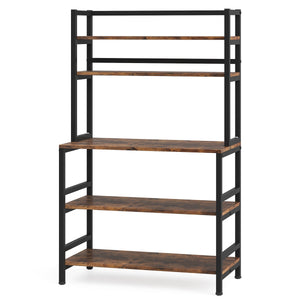
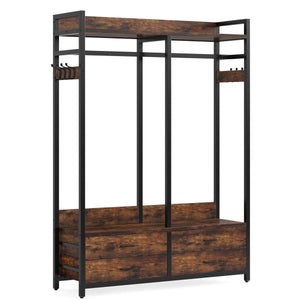
The Tribesigns Freestanding Closet Organizer with 6 Shelves is a good example of this middle ground. It measures 47.24"W × 15.74"D × 70.86"H, with six shelves, a hanging section, a powder-coated metal frame, and particle-board shelving. At 15.74 inches deep, it is notably shallower than a typical full-depth wardrobe cabinet, which makes it easier to place along a bedroom wall without pulling too far into the room.
The design also uses height sensibly. Rather than spreading storage across a long, low unit, it climbs to just under 71 inches and keeps the footprint under four feet wide.
At the time of writing, the organizer is listed at $185.99, putting it in the middle of the market rather than the disposable-rack end. That price makes the most sense if you genuinely need both hanging and shelving; if all you want is somewhere to hang ten shirts, a basic rack is the better buy.
How Much Clothing Will It Actually Hold?
Retail specifications for this Tribesigns organizer design list a 32.3-inch hanging rod. Closet-planning guidance commonly allows roughly 1 inch of rod space for a shirt or blouse, while bulkier dresses, jackets, and coats need about 2 to 3 inches each.
That gives you a useful planning range. A 32.3-inch rod can hold roughly 30 lightweight shirts or blouses at close spacing, or closer to 10–16 bulkier jackets and coats. A mixed wardrobe will land somewhere between those numbers, and leaving a little breathing room makes clothes much easier to browse.
Those are planning estimates, not a manufacturer-rated garment count. Hanger thickness, fabric bulk, and how tightly you pack clothes will change the result.
The shelving deserves the same caution. The organizer has four smaller side shelves plus two larger lower shelves, and comparable specifications for this design show side-shelf dimensions around 11.81"W × 15.74"D.
That is enough depth for many folded-clothing stacks, baskets, or shoe boxes, but there is too much variation in box and bin sizing to publish a responsible universal count without a physical fit test.
For Small Bedrooms, Depth Matters More Than Width
Width gets most of the attention when people measure a small room, but depth is often what determines whether a storage piece feels intrusive.
A 48-inch-wide organizer can work surprisingly well along an empty wall if it stays relatively shallow. A deeper wardrobe cabinet, by contrast, can narrow the walkway between the bed and storage even when the room technically has enough floor space.
That is where the 15.74-inch depth of the Tribesigns organizer works in its favor. It provides useful shelving for folded clothes, shoes, and bins without projecting as far into the room as many enclosed wardrobes.
Before buying, measure more than the available wall width. Check the remaining walkway once the organizer, bed, nightstand, and any open doors are accounted for.
If you have to turn sideways to get around the bed every morning, the organizer is too deep for the room.

Freestanding Closet Organizers for Bedrooms Without Closets
When there is no built-in closet, clothing storage becomes part of the room rather than something hidden behind a door. That means the organizer has to do more than hold clothes—it also needs to keep the bedroom from looking improvised.
A freestanding organizer with both hanging space and shelves works better here than a basic garment rack because it keeps more categories in one place. Shirts and jackets can stay on the rod, while folded clothes, shoes, bags, and bins have their own shelves instead of spilling onto the floor or nearby furniture.
Open storage also works best when you give each shelf a clear job. Keep everyday shoes low, folded clothes at an easy-to-reach height, and smaller items such as socks or accessories inside matching bins.
Do not try to fill every inch. Leaving a little open space makes clothes easier to access and keeps the organizer from looking overloaded, which matters more when it is fully visible in the bedroom.
Best for an Existing Walk-In Closet
A walk-in closet can still be badly designed. Many have one long rod, one high shelf, and a surprising amount of wall space doing very little.
A freestanding organizer is useful here because it lets you correct one weak zone without tearing out the entire closet. Put it on an empty wall for folded clothes and shoes, or use it for the category the existing closet handles poorly.
Do not automatically add the largest system that fits. Walk-ins need circulation space, and filling every wall with deep storage can turn a roomy closet into a narrow corridor.
For an already functional walk-in, a smaller freestanding organizer often works better as a supplement than as a replacement.
Best for Frequent Movers
People who move every year or two should shop differently from homeowners. The highest-capacity closet system is not automatically the best value if taking it apart becomes a weekend project every time your lease changes.
Portable fabric wardrobes and simple steel garment racks have an advantage here. They are generally lighter, less expensive, and easier to relocate than furniture-style organizers.
The tradeoff is appearance and structure. Fabric shelving can feel temporary, while a very light rack may become frustrating once loaded with heavy coats.
If you expect to stay only six months, I would not spend much on a furniture-style closet. For a two- or three-year lease, paying more for something that looks intentional in the bedroom and can move with you is easier to justify.
Measure These Three Things Before You Buy
Start with usable wall width, not the room’s listed dimensions. Baseboards, outlets, closet doors, window trim, and nearby furniture can remove several inches from what initially looks like open space.
Next, measure depth into the room. Mark the organizer depth on the floor with painter’s tape and walk around it for a minute; this simple test tells you far more than staring at a product photo.
Finally, check the height and the vertical clearance above it. Tall storage makes sense in a small room, but only if it does not interfere with vents, sloped ceilings, shelves, or anything else overhead.
Measurements matter more than storage claims. A perfectly organized 60-inch-wide system is useless if the only available wall is 55 inches.

What I Would Skip
I would skip very cheap single-rail garment racks as a primary closet unless your wardrobe is unusually small. They are fine as overflow storage, laundry-room racks, or a place to stage a week of outfits, but they solve only one part of the storage problem.
I would also avoid buying a huge modular system simply because it technically fits the wall. Renters benefit from flexibility, and furniture that only works in one specific room can become a liability at the next address.
Permanent built-ins are another category I would reserve for long-term living. They can be beautiful and extremely efficient, but the investment makes far more sense when you control the property.
The goal in a rental is not to recreate a luxury custom closet. It is to get most of the everyday function without designing the room around something you cannot take with you.
FAQs
What is the best type of closet organizer for renters?
For most renters with a mixed wardrobe, a freestanding garment rack with both shelves and hanging space is the most versatile option. It handles clothing, shoes, bags, folded items, and bins without requiring a full built-in closet system.
Are freestanding closet organizers good for small bedrooms?
They can be, but depth matters as much as width. Look for a tall, relatively shallow organizer and measure the remaining walkway between the unit and your bed or other furniture before buying.
Can I use a freestanding organizer in a bedroom with no closet?
Yes. An open freestanding wardrobe can create a defined clothing-storage zone along an unused wall, making it particularly useful in studios, older apartments, converted bedrooms, and guest rooms.
Do freestanding closet organizers require drilling?
The main structure of a freestanding organizer does not depend on wall-mounted closet rails. Some tall organizers still include anti-tip restraints that attach to a wall, so follow the manufacturer’s safety instructions and check your rental agreement before installation.
Is a garment rack with shelves better than a regular clothing rack?
For a mixed wardrobe, usually yes. A regular rack is better if hanging space is your only problem, while shelves make the organizer much more useful for shoes, folded clothes, bags, baskets, and storage boxes.
What depth works well for a small-bedroom closet organizer?
There is no single ideal dimension, but shelves around 14–16 inches deep are commonly useful for folded clothing. Shallower storage also leaves more circulation space in compact bedrooms, which is why room clearance should be checked before purchase.
Read more: