









What is MDF?
Medium-Density Fiberboard (MDF) is a type of engineered wood made by breaking down hardwood or softwood residuals into fine wood fibers. These fibers are combined with wax and resin under high pressure and heat to form smooth, dense panels. Compared to other sheet materials like particle board or plywood, MDF typically has a uniform surface, is denser than particle board, and offers an ideal base for painting or veneering.

Pros and Cons of Using MDF for Cabinets
Pros
Smooth, Paint-Ready Surface
MDF has a uniform, knot-free texture that takes paint, laminate, or veneer extremely well. This makes it perfect for modern cabinets with a flawless, sleek finish.
Dimensional Stability
Unlike solid wood, MDF won’t easily warp, crack, or expand with humidity changes. Its flatness and stability make it especially useful in areas with fluctuating temperatures.
Cost-Effective & Sustainable
Since MDF is made from recycled wood fibers and by-products, it’s typically more affordable than solid wood while also being eco-conscious.
Consistent Quality & Easy Workability
Its even density ensures consistent performance across panels. MDF machines “like butter,” allowing precise cutting, shaping, and edge detailing without splintering.
Flat and Uniform Appearance
Because there are no natural wood grains or knots, every panel looks identical—ideal for achieving a clean, modern style.
Some users have also discovered that MDF is a good material for custom speakers. Due to its uniform density, good stability, and ease of processing, MDF is widely used in custom speaker manufacturing, making it a more professional choice than solid wood. Most high-end hi-fi and DIY speakers are indeed made of MDF, which is then surface-finished with veneer or painted to enhance the appearance.
Cons
Poor Moisture Resistance
MDF quickly absorbs water, which can cause swelling or deterioration if edges aren’t properly sealed.
Weaker Structural Strength
It lacks the natural grain of solid wood and isn’t as robust, making it more prone to dents or damage under heavy use.
Fastener Limitations
Screws and nails don’t hold as well in MDF and can cause splitting unless you drill pilot holes or use specialized connectors.
Potential VOC Emissions
MDF often contains formaldehyde-based resins, which can release volatile organic compounds (VOCs) over time. This makes proper ventilation and surface sealing essential.
Heavy and Dusty
It’s heavier than plywood, and cutting it generates a lot of fine dust—protective gear is advised during handling.
What is Particle Board?
Particle board is an engineered wood product made from wood chips, sawdust, and resin that are compressed under heat and pressure into sheets. Because it makes use of wood by-products, particle board is often cheaper than plywood or MDF and is widely used in budget-friendly furniture and cabinetry. Its smooth surface is usually finished with laminate, veneer, or melamine to improve durability and appearance.

Pros and Cons of Using Particle Board for Cabinets
Pros
Affordable Option
Particle board cabinets are significantly less expensive than plywood or solid wood, making them attractive for homeowners on a budget or large-scale projects like rental units.
Lightweight and Easy to Handle
Compared to plywood, particle board is lighter, which makes installation of wall cabinets easier and less labor-intensive.
Smooth, Uniform Surface
Its flat, consistent surface works well for laminates and veneers, allowing manufacturers to create cabinets that mimic the look of wood at a lower cost.
Wide Availability
Since particle board is mass-produced, it’s widely available and comes in various thicknesses and finishes suitable for cabinetry.
Cons
Poor Moisture Resistance
Standard particle board swells and deteriorates quickly when exposed to water. In kitchens and bathrooms—where humidity and spills are common—this is a serious drawback.
Limited Durability
Particle board lacks the strength of plywood or solid wood, meaning cabinet boxes may sag under heavy countertops or cookware over time.
Weak Screw-Holding Capacity
Screws and fasteners tend to loosen more easily in particle board. This is particularly problematic for cabinet hinges and drawer slides, which undergo frequent use.
Shorter Lifespan
While particle board may look good when new, it generally doesn’t hold up as long as plywood cabinets, especially in high-use kitchens.
Potential VOC Emissions
Some particle board uses urea-formaldehyde resin, which can off-gas volatile organic compounds (VOCs). Sealing edges and choosing low-emission boards helps mitigate this risk.
MDF Vs Particle Board — What is the Difference?
Materials
MDF (Medium Density Fiberboard) is made from fine wood fibers mixed with resin and wax. Its uniform fiber structure results in a dense, smooth core.
Particleboard, on the other hand, is made from larger wood chips, sawdust, and resin. Its texture is coarser, with visible wood particles in the core.
Manufacturing Process
Medium-Density Fiberboard is created by breaking wood down into fine fibers, blending them with resin, and then compressing the mixture under intense heat and pressure. This method produces dense, smooth panels with a uniform structure throughout.
By contrast, particle board is formed from larger wood particles, chips, and sawdust bound with resin. The layers are pressed and heat-cured into sheets. While this process is quicker and more economical, the resulting boards are less dense and generally weaker than MDF.
Properties
Because of its fine fibers, MDF has a dense, smooth surface that takes paint and finishes exceptionally well. Particle board lacks this uniformity; its surface is rougher and typically requires a laminate or veneer to look attractive and resist damage.
Life Expectancy
MDF cabinets generally last longer in indoor settings, especially when they are sealed or painted to resist moisture. Particle board tends to have a shorter service life and is more prone to sagging, swelling, or breaking down under frequent use.
Cost
In terms of pricing, MDF usually falls in the mid-range—cheaper than plywood but more expensive than particle board. Particle board is the most affordable option, which is why it is widely used in low-budget cabinetry.
Uses
MDF is a popular choice for cabinet doors, shelves, decorative panels, and any application that requires a smooth, paintable surface. Particle board is more often used for cabinet boxes, inexpensive bookcases, and furniture where cost efficiency outweighs durability.
Moisture Resistance
Standard MDF will swell if exposed to water, though moisture-resistant versions exist for kitchens and bathrooms. Particle board, however, performs very poorly with moisture and can quickly disintegrate when wet, making it unsuitable for damp environments.
Screw-Holding Strength
Screws and fasteners generally stay more secure in MDF, though pilot holes are recommended to prevent splitting. Particle board struggles in this area; screws loosen easily over time, which can be problematic for hinges and drawer slides in cabinets.

Workability
MDF is easier to cut, rout, and shape, producing clean edges that make it ideal for detailed designs. Particle board is more brittle during machining, with edges that chip or crumble, limiting it to simpler construction.
Weight
Because of its density, MDF is noticeably heavier, which adds stability but makes large cabinet installations more difficult. Particle board is lighter and easier to handle, though its reduced weight comes at the expense of strength.
Environmental / VOC Emissions
Both MDF and particle board typically use formaldehyde-based resins, which can release VOCs. However, low-VOC and CARB-compliant versions are available for environmentally conscious projects. Choosing certified materials is especially important for indoor cabinetry.
Aesthetic & Finishing Options
MDF provides an exceptionally smooth base for paint, veneer, or laminate, making it the preferred option for modern painted cabinets. Particle board usually requires a laminate or melamine finish to look attractive, as its raw surface is not visually appealing.
Load-Bearing Capacity
Thanks to its density, MDF can support moderate loads in shelving and cabinet structures, though it is not as strong as plywood. Particle board has the weakest load capacity of the common engineered woods, and shelves made from it tend to sag under weight.
Conclusion
When comparing MDF and particle board, the choice largely depends on your priorities. MDF provides a smoother finish, stronger durability, and greater design flexibility, making it ideal for cabinets and furniture that need to look polished and stand the test of time. Particle board, while more affordable, is best suited for lightweight or budget-conscious projects where longevity isn’t the main concern.
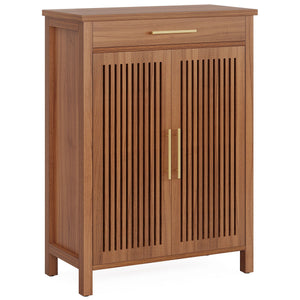
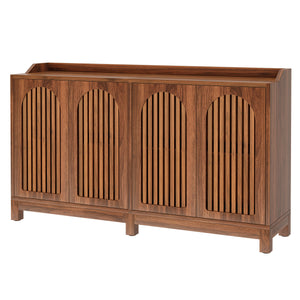
At Tribesigns, we carefully select materials that balance quality, design, and practicality. Some of our pieces, such as shoe cabinets, incorporate MDF to ensure stability, a clean finish, and compliance with modern standards. If you’re looking for furniture that combines smart design with dependable materials, we invite you to explore Tribesigns furniture range and find the perfect fit for your home.
Related read:
MDF vs Plywood Furniture: Which Material is Best for You?