









Table of Contents
- What Are the Most Common Wardrobe Materials?
- Wardrobe Materials Comparison: Durability, Safety, Lifespan & Cost
- Best Wardrobe Materials for Seniors and Children
- Best Wardrobe Materials for Young Adults
- Which Wardrobe Finishes Are Best?
- Final Thoughts: Which Wardrobe Material Should You Choose?
- Is Plywood Better Than MDF for Wardrobes?
- Which Wardrobe Material Has the Lowest Formaldehyde Emissions?
A wardrobe is one of those pieces of furniture you use every day but rarely think about—until a shelf begins to sag, a door no longer closes properly, or the finish starts showing wear. While size and design often get the most attention, the material underneath matters just as much. It affects how sturdy your wardrobe feels, how well it handles everyday use, and how much maintenance it may need over time.
So, what is the best material for a wardrobe? The answer depends on your budget, bedroom conditions, storage needs, and preferred style. This guide compares the most common wardrobe materials, their advantages and limitations, and what to look for before making a purchase.
What Are the Most Common Wardrobe Materials?
Most wardrobes are made from solid wood or engineered wood, although metal, glass, and other materials may also be used for certain components. Each material serves a different purpose. A wardrobe does not necessarily need to be made entirely from one material to perform well. Many designs combine materials to balance durability, appearance, weight, and cost.
Best Wardrobe Material #1: Solid Wood
Material Composition: A solid wood wardrobe is made from natural timber, such as oak, maple, pine, or walnut, rather than compressed wood fibers or particles. Different wood species offer distinct grain patterns, hardness levels, and colors, giving solid wood furniture its natural character. When choosing the best wood for wardrobe construction, consider the wood's durability, appearance, cost, and suitability for your indoor environment.
Advantages & Disadvantages: Solid wood is one of the most durable wardrobe materials because of its strength, natural appearance, and ability to be repaired or refinished. A well-constructed solid wood wardrobe can last for decades with proper care. However, solid wood is typically heavier and more expensive than an engineered wood wardrobe made from materials such as MDF or particle board. It may also expand, contract, or warp when indoor humidity changes significantly. If your priority is long-term durability and a natural appearance, solid wood can be an excellent choice for the best wardrobe material, provided it fits your budget and maintenance preferences.
Best Wardrobe Material #2: Plywood
Material Composition: A plywood wardrobe is made from multiple thin layers of wood veneer bonded together, usually with alternating grain directions. This cross-layered construction improves dimensional stability, making plywood suitable for wardrobe frames, side panels, shelves, and doors. Plywood is one of the most versatile wardrobe materials for furniture that needs a balance of strength and stability.
Advantages & Disadvantages: Properly manufactured plywood offers good structural strength, screw-holding performance, and resistance to warping. Quality plywood can also handle occasional humidity changes better than standard MDF or particle board, although performance depends on the plywood grade, adhesive, and edge protection. When comparing MDF vs plywood for wardrobe construction, plywood is often preferred for structural strength and screw-holding ability, while MDF is useful for smooth, painted surfaces. BWR plywood wardrobe and BWP plywood wardrobe are terms used in some markets for plywood grades designed for improved moisture resistance; however, buyers should verify the applicable grade standards and product specifications rather than assume all plywood is waterproof. Plywood generally costs more than particle board and standard MDF, and unfinished edges require proper sealing.
Best Wardrobe Material #3: MDF (Medium-Density Fiberboard)
Material Composition: MDF is an engineered wood product made by breaking down wood into fine fibers, mixing them with resin, and compressing them under heat and pressure. An MDF wardrobe typically has a smooth, uniform surface, making it especially suitable for painted wardrobe doors, decorative panels, and modern furniture designs.
Advantages & Disadvantages: MDF offers a smooth finish, a consistent appearance, and flexibility for decorative shaping. It is often more affordable than solid wood or quality plywood. However, standard MDF can swell when exposed to water, and damaged edges can be difficult to repair. Its weight and relatively limited edge screw-holding performance also require suitable hardware and careful assembly. Is MDF good for wardrobes? Yes, MDF can be a practical choice for wardrobes in dry indoor environments, particularly when a smooth painted finish is desired. In an MDF vs particle board comparison, MDF generally offers a smoother surface for painting and detailed designs, while particle board is often selected for budget-friendly furniture. When comparing MDF vs plywood for wardrobe use, consider structural requirements, finish preferences, moisture exposure, and budget rather than assuming one material is always better.
Best Wardrobe Material #4: Particle Board
Material Composition: Particle board, also known as chipboard, is manufactured by combining wood chips, sawdust, and other wood particles with resin before compressing them into panels. A particle board wardrobe is commonly covered with melamine, laminate, or wood-look finishes and is widely used in affordable ready-to-assemble furniture. This makes particle board one of the most accessible wardrobe material types for shoppers on a limited budget.
Advantages & Disadvantages: Particle board is cost-effective, widely available, and offered in many decorative finishes. It is suitable for everyday storage when properly supported and assembled. Its limitations include relatively low resistance to prolonged moisture exposure, potential swelling at unsealed edges, and reduced screw-holding performance after repeated assembly and disassembly. Is particle board good for wardrobes? It can be a good budget option for a bedroom or closet that stays dry, especially when the wardrobe is properly assembled and its edges are protected. However, if you need durable wardrobe materials for long-term use or are concerned about moisture, compare the panel quality, edge sealing, hardware, and overall construction before choosing particle board.
Best Wardrobe Material #5: HDF (High-Density Fiberboard)
Material Composition: HDF is made from refined wood fibers bonded and compressed under high pressure to produce dense, smooth panels. Compared with MDF, HDF generally has a higher density. In wardrobe construction, thin HDF panels are commonly used for back panels, drawer bottoms, and selected decorative components rather than entire wardrobe frames. An HDF wardrobe may therefore use HDF for specific components while relying on other materials for its main structure.
Advantages & Disadvantages: HDF provides a smooth surface, relatively good hardness, and useful dimensional stability when properly manufactured. Thin panels are practical for wardrobe backs and drawer bottoms. However, HDF is not automatically waterproof, and its high density can make thicker panels heavy. It is also less commonly used as the primary structural material for freestanding wardrobes. When evaluating HDF wardrobe components, check the panel thickness, intended application, and moisture protection. HDF can be useful as part of a wardrobe, but it should not automatically be considered the best material for wardrobe frames or moisture-prone areas.
Best Wardrobe Material #6: Metal
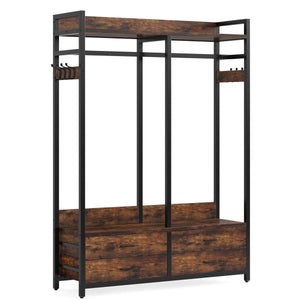
Material Composition: Metal wardrobes are typically constructed from steel, iron, or aluminum components. Steel tubing and metal frames are especially common in open wardrobes, freestanding closet organizers, and garment racks. Metal structures may also be combined with engineered wood shelves, drawers, or decorative panels. Compared with enclosed wooden wardrobes, open metal designs offer a different approach to clothing storage and organization.
Advantages & Disadvantages: Metal offers strong structural performance, good dimensional stability, and resistance to many types of everyday wear. It is particularly useful for open wardrobe designs and adjustable storage systems. However, metal furniture can be susceptible to rust if protective coatings are damaged, and some designs may appear more industrial than traditional wooden wardrobes. Overall stability depends on the frame design, joints, and load distribution. When deciding which wardrobe material lasts the longest, consider not only the material itself but also the frame construction, finish quality, hardware, maintenance requirements, and indoor conditions. A well-made metal wardrobe can be durable, while a poorly protected frame may corrode over time.
Wardrobe Materials Comparison: Durability, Safety, Lifespan & Cost
| Material | Durability | Moisture Resistance (1–5) | Load-Bearing Strength (1–5) | Formaldehyde Emissions (EPA Limit) | Estimated Lifespan | Material Cost (USD/sq. ft.) |
|---|---|---|---|---|---|---|
| Solid Wood | High | 2–3 / 5 | 4–5 / 5 | Generally Low | 20–50+ years | $1.50–$13.50 |
| Plywood | High | 3–4 / 5 | 4–5 / 5 | ≤0.05 ppm | 15–30+ years | $1.56–$4.06 |
| MDF | Moderate | 1–2 / 5 | 2–3 / 5 | ≤0.11 ppm | 10–20 years | $1.09–$1.88 |
| Particle Board | Moderate–Low | 1–2 / 5 | 1–3 / 5 | ≤0.09 ppm | 5–15 years | $0.78–$1.41 |
| HDF | Moderate–High | 2–3 / 5 | 2–4 / 5 | Varies | 10–20 years | $1.25–$4.02 |
| Metal | High | 4–5 / 5 | 4–5 / 5 | Generally Very Low | 15–30+ years | $57.01–$98.94 |
Material Cost Notes: Estimated U.S. retail prices per sq. ft., based on 3/4-inch (19 mm) thickness. Solid wood prices are converted from board-foot rates; metal prices refer to solid plates. Costs vary by grade, supplier, and location.
Best Wardrobe Materials for Seniors and Children
For seniors and children, solid wood and low-emission plywood are recommended for their durability, structural stability, and generally lower formaldehyde concerns when properly manufactured. When choosing the best material for wardrobe doors, consider low-emission wardrobe finishes, smooth edges, and easy-to-use handles. Look for verified EPA TSCA Title VI compliance where applicable, and secure wardrobes to the wall to reduce tipping risks.
Best Wardrobe Materials for Young Adults
For young adults, EPA TSCA Title VI-compliant MDF and particle board offer affordable, practical storage, especially for apartments and smaller bedrooms. In the MDF vs. plywood comparison, MDF is often more budget-friendly and suitable for painted doors, while plywood provides better structural strength. A laminate wardrobe can also be easy to maintain with properly sealed edges. For those who move frequently, powder-coated metal wardrobes are another practical option with low formaldehyde concerns from the metal frame itself.
Which Wardrobe Finishes Are Best?
Common wardrobe finishes include:
Laminate: A laminate wardrobe offers good scratch resistance, easy cleaning, and various colors and realistic wood-look designs.
Melamine: An affordable wardrobe laminate finish commonly used on MDF and particle board, offering easy maintenance but requiring properly sealed edges.
Wood Veneer: A thin layer of real wood over an engineered core, providing natural wood grain and a premium look but requiring more careful maintenance.
Painted Finish: Ideal for customized colors and styles. A PU paint wardrobe finish can offer a smooth, durable surface, depending on its quality and application.
So, what is the best material for wardrobe doors? Laminate is a popular choice for everyday wardrobes because it balances durability, affordability, easy maintenance, and design variety. Wood veneer suits those seeking a natural look, while painted finishes offer greater customization. Choosing the right finish also depends on your wardrobe door materials and preferred style.
Final Thoughts: Which Wardrobe Material Should You Choose?
The best material for a wardrobe depends on your budget. Choose solid wood if you value natural character and the ability to repair or refinish your furniture. Consider plywood when structural strength is a priority. MDF is a practical option for smooth painted designs, while particle board can provide affordable everyday storage.
When choosing the best material for wardrobe doors, consider durability and maintenance alongside appearance. Quality wardrobe finishes, such as a laminate wardrobe finish, can provide scratch resistance and easy cleaning. Sturdy wardrobe door handles and reliable hardware also improve everyday usability.
Frequently Asked Questions
What Is the Best Material for a Wardrobe?
Quality plywood is a strong all-around choice for durability, stability, and value. Solid wood offers natural beauty and repairability, while MDF and particle board provide more affordable alternatives. The best option depends on your budget, storage needs, and bedroom conditions.
Is MDF Good for Wardrobes?
Yes. MDF is a practical choice for wardrobes in dry bedrooms, especially for painted doors and decorative panels. Its smooth surface allows for attractive finishes, but proper edge sealing and protection from moisture are important for long-term performance.
Is Plywood Better Than MDF for Wardrobes?
Plywood is generally better for structural strength, making it suitable for wardrobe frames and shelves. MDF is often more affordable and offers a smoother surface for painted designs. Choose based on whether durability, appearance, or budget matters most.
Which Wardrobe Material Lasts the Longest?
Well-constructed solid wood and quality plywood wardrobes can provide decades of use. Solid wood also offers repair and refinishing options. However, actual lifespan depends on material grade, construction quality, humidity, hardware, and maintenance.
What Is the Cheapest Material for a Wardrobe?
Particle board is generally the cheapest common wardrobe material, making it suitable for budget-friendly storage. MDF is another affordable option. For better long-term value, look for properly sealed edges, sturdy shelves, and reliable hardware.
Which Wardrobe Material Is Moisture Resistant?
Moisture-resistant plywood and properly coated metal are practical choices for humid environments. Standard MDF and particle board are generally more vulnerable to water damage. Regardless of the material, proper sealing and bedroom ventilation help extend wardrobe life.
Which Wardrobe Material Has the Lowest Formaldehyde Emissions?
Unfinished solid wood and uncoated metal generally have fewer formaldehyde emission concerns than composite wood panels made with formaldehyde-emitting resins. However, adhesives and finishes can affect emissions. MDF, plywood, and particle board can also meet verified low-emission requirements.
How Can I Choose a Low-Formaldehyde Wardrobe?
Look for EPA TSCA Title VI compliance when buying wardrobes made from regulated composite wood products in the U.S. Check the manufacturer's material information and any available low-emission certifications. Remember that adhesives, coatings, and other components may also affect indoor air quality.
What Is the Best Material for Wardrobe Doors?
MDF is a popular choice for painted wardrobe doors because of its smooth surface, while plywood provides structural stability. Solid wood offers natural grain and repairability. Glass wardrobe doors and aluminum-framed designs are additional options for contemporary interiors.
Which Wardrobe Finish Is Best for Everyday Use?
A quality laminate finish is a practical choice because it offers scratch resistance, easy cleaning, and various wood-look designs. Melamine is generally affordable, wood veneer provides natural character, and painted finishes offer greater color flexibility. Always check finish quality and edge sealing.