









Which Washer and Dryer Setups Can Use a Countertop?
The door location is the first thing to check. Front-load machines open from the front, leaving the top available. Top-load washers need open space above the lid and are rarely compatible with a full countertop.
Whirlpool recommends allowing at least two feet of clearance above a top-load washer so the lid can open comfortably. A fixed or direct-mounted countertop would interfere with that space.
|
Washer and dryer setup |
Can you add a countertop? |
Main consideration |
|
Side-by-side front-load machines |
Usually yes |
Check width, depth, vibration, and controls |
|
Front-load machines with front controls |
Usually the best fit |
Most of the top surface remains usable |
|
Front-load machines with rear controls |
Sometimes |
The countertop must not block the control panel |
|
Top-load washer |
Usually no |
The lid needs open space above it |
|
Stacked washer and dryer |
No |
There is no horizontal surface to cover |
|
Machines on tall pedestals |
Possibly |
The finished work surface may be too high |

The two appliances should also be close in height. A small difference may be manageable with a purpose-built design, but a noticeable height mismatch can leave the countertop uneven or poorly supported.
Can the Countertop Sit Directly on the Machines?
It can, but only when the countertop is designed to work that way.
A removable washer dryer topper typically rests across the appliance tops and uses anti-slip pads or other contact points to reduce movement. This is different from placing a random board, stone slab, or leftover kitchen countertop directly on two machines.
A direct-mounted topper should be:
- Sized for the usable appliance surface
- Light enough for the intended setup
- Stable across both machines
- Protected underneath with anti-slip pads
- Easy to remove when the appliances need service
- Positioned so it does not cover controls or connections
The appliance manuals should always take priority. Some manufacturers discourage placing heavy objects directly on top of their machines, while others may specify required clearances or installation conditions.
When direct placement is not appropriate, the countertop should be supported independently by walls, cabinets, or side panels.
Removable Topper or Built-In Countertop?
The key difference is where the countertop gets its support.
Removable Washer Dryer Topper
A removable topper sits directly on two side-by-side machines. It is the easiest option if you want more folding space without remodeling the laundry room.
Many designs include anti-slip pads and raised edges to help keep the surface steady and stop small items from falling behind the appliances.
This option works well for renters, quick upgrades, and anyone who wants a countertop that can be lifted off for cleaning or repairs.
Fit is important. A topper that is too small may shift, while one that is too deep can interfere with hoses, vents, or wall clearance.
Wall-supported Countertop
A wall-supported countertop is mounted above the appliances rather than placed on them.
It keeps the weight off the washer and dryer and leaves room for vibration, cleaning, and service access. It is also a better choice for heavier materials.
The brackets and wall framing must be strong enough to support the countertop and anything stored on it.
Cabinet-supported Countertop
A cabinet-supported countertop rests on cabinets or side panels around the appliances.
This creates a built-in look and can support heavier materials such as quartz, stone, or thick butcher block.
It works best in a full laundry room remodel. The main drawbacks are higher cost and less flexibility if you replace the appliances later.
For a quick, low-commitment upgrade, a removable topper is usually the simplest choice. Wall- and cabinet-supported counters make more sense for permanent renovations.

How Do You Keep a Washer Dryer Countertop From Sliding?
A well-fitted countertop should not drift across the machines during every load.
Look for a design with:
- Anti-slip pads underneath
- A broad, even contact area
- Raised edges around the work surface
- Smoothly finished corners
- Enough weight to feel stable without overloading the appliances
- A width and depth that closely match the usable appliance tops
Anti-slip pads help, but they should not be used to hide a washer vibration problem. If the countertop continues to shift, inspect the appliance level, floor condition, load balance, and installation before adding stronger adhesive.
Raised edges are useful for more than stability. They can stop dryer sheets, detergent caps, socks, and small bottles from vibrating off the back or sides.
A Ready-Made Option for Side-by-Side Front-Load Machines
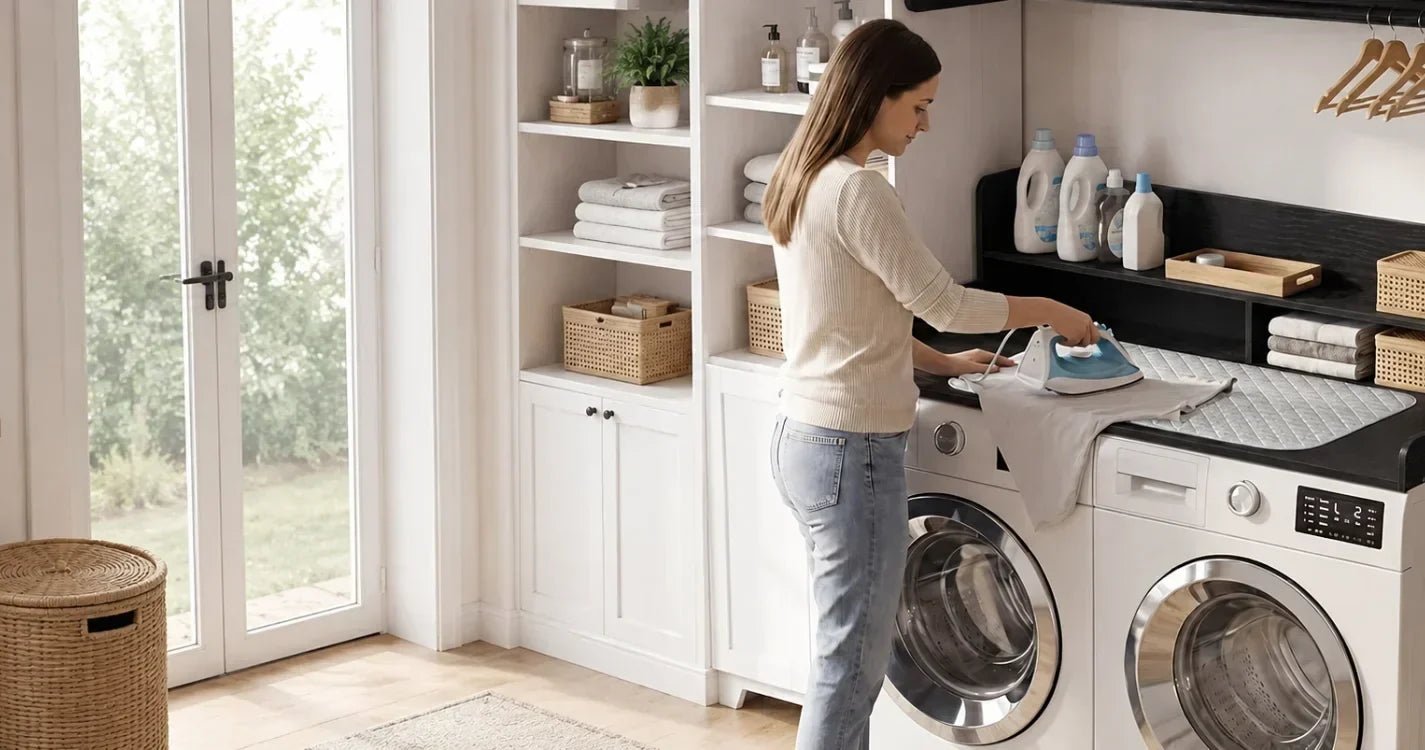
For laundry areas suited to a removable topper, Tribesigns offers two 2-tier washer dryer countertops designed to combine folding space with open storage.
The 2-Tier Washer Dryer Countertop with Wave Edge measures approximately 53.94 inches wide by 27.56 inches deep. It includes six anti-slip pads, three-inch raised edges, a stain-resistant melamine surface, and a wave-shaped back rail that helps keep laundry supplies from slipping behind the appliances.
Households that regularly press shirts or smooth clothes may prefer the 2-Tier Washer Dryer Countertop with Ironing Mat. It has a similar 53.94-by-27.56-inch footprint and adds a 33.4-by-18.9-inch ironing mat to the work surface.
Both products are designed for quick assembly and include an upper shelf for baskets, detergent, or folded clothes. Compatibility still depends on the size, shape, and instructions of your washer and dryer, so measure the appliances before ordering.

Frequently Asked Questions
Can I Put a Wood Countertop Directly on My Washer and Dryer?
A purpose-built, lightweight wood or engineered-wood topper may sit directly on compatible appliances. A heavy piece of butcher block should usually have independent wall, cabinet, or side-panel support.
Check the appliance manuals before adding weight directly to the machines.
Can You Put a Countertop over a Top-Load Washer?
A full countertop usually will not work because it prevents the washer lid from opening. A side counter, rolling cart, or partial work surface beside the machine is a more practical choice.
How Do I Stop a Washer Dryer Countertop from Sliding?
Start by leveling the washer and confirming that it does not move excessively. A properly fitted countertop with anti-slip pads will be more stable than an oversized or loosely placed surface.
Do not rely on adhesive to correct an appliance vibration problem.
Should a Countertop Touch the Washer and Dryer?
A removable topper is designed to touch the machine tops through protective contact pads. A wall- or cabinet-supported counter should normally sit slightly above the appliances rather than resting on them.
Can I Use the Countertop for Ironing?
Only when the countertop includes a heat-resistant ironing surface or is protected by a suitable ironing mat. Do not place a hot iron directly on a melamine, laminate, or finished wood surface.
Is a Washer Dryer Countertop with a Shelf Worth It?
It can be, especially in a small laundry room. The countertop creates folding space, while the shelf keeps supplies off the main work area.
A shelf is particularly useful when there is no room for wall cabinets or when you want to avoid drilling into the wall.