










An upholstered entryway bench wins the moment you sit down. A wooden bench wins in year three, when the fabric version has pulled right where everyone kicks off their shoes and the wood one still wipes clean with a damp cloth.
We sell both kinds, so we have no reason to steer you. Here's the version we'd tell a friend instead: the two questions that actually decide this for your house, and where each option goes wrong.
Table of Contents
- Two Questions to Consider Before Choosing an Entryway Bench
- What the Cushion Actually Costs You
- The Tag on the Bottom Tells You More Than the Product Page
- Where Wood Quietly Wins
- Where Wood May Need a Little More Comfort
- A Balanced Choice: The Best of Both Materials
- Five-second Decision
- FAQ
Two Questions to Consider Before Choosing an Entryway Bench
Before deciding between an upholstered and wooden entryway bench, think about how your household actually uses the space. The right choice often depends less on appearance and more on everyday routines.
Is Your Entryway Exposed to Moisture and Outdoor Mess?
If your entryway regularly deals with wet shoes, rain, snow, or pets coming inside after outdoor activities, maintenance becomes an important consideration.
A wooden bench or sealed surface is generally easier to wipe clean, while an upholstered bench may require more attention to fabric selection and care. That does not mean upholstery cannot work in a busy entryway—durable, easy-care fabrics can make a comfortable seat practical for everyday use.
The best choice is the one that matches your home's routine.
How Does Your Family Use the Bench?
Think about what happens at your front door every day.
If the bench is mainly used for quick moments—putting on shoes, setting down a bag, or organizing essentials—a firm wooden seat may provide everything you need.
But if the bench becomes a place where family members sit for longer periods, help children get ready, or spend more time during daily routines, added cushioning can make a noticeable difference.
Comfort is not only about appearance—it is about making everyday moments easier.
What the Cushion Actually Costs You
An upholstered bench stays comfortable for exactly as long as the cushion holds its shape. That's a material question, and it's buried under the fabric where you can't see it. Three numbers decide whether a cushioned bench still feels good in year two.
Foam density. Look for 1.8 lb/ft³ at minimum, and 2.0–2.5 on anything you'll sit on daily. Budget foam runs around 1.2, and it flattens into a permanent dent within a year — always in the same spot, right where you sit to tie your shoes.
Cushion thickness. Two inches is the floor. Under that, you're sitting on the frame with extra steps.
Fabric construction, not fabric name. "Linen" tells you nothing. Double rub count does — that's the abrasion test, and 30,000 is the residential minimum for a high-traffic area like an entryway. Velvet and bouclé look wonderful and snag on jean rivets and pet claws. Tight, flat weaves survive a doorway better than anything with texture.

The Tag on the Bottom Tells You More Than the Product Page
Almost nobody reads it: a one- or two-letter cleaning code on the underside of the cushion.
- W — water-based cleaners only. The easiest to live with.
- S — solvent cleaners only. Water makes it worse. Common on some synthetics and velvets.
- W/S — either one works.
- X — vacuum only. No liquid at all.
An X-coded fabric in an entryway is a mistake, however good it looks online. And if the cover zips off, you've solved most of this before you start: a washable cover turns an upholstered bench from a maintenance problem into a laundry problem. That single feature matters more than the fiber content.
A note on color, since it comes up constantly: off-white and cream are the most photographed and the worst-performing. Mid-tones and patterns hide everything. If you want light, get a removable cover and wash it.

Where Wood Quietly Wins
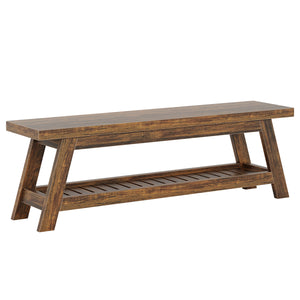
Wood's real advantage isn't that it looks traditional. It's that it can be fixed.
A scratch on a wood bench is a Saturday afternoon with sandpaper. A snag in upholstery is a re-upholstery bill, or a bench you learn to live with. That gap compounds. A wood bench that gets knocked around a hundred times over five years can be brought back to new. An upholstered one that gets knocked around a hundred times is just an upholstered one that's been knocked around a hundred times.
Wood also doesn't hold odor. Fabric and foam absorb whatever comes through the door — wet dog, gym shoes, rain on a wool coat. That's less a hygiene problem than an accumulation problem, and it's the reason so many upholstered entryway benches get replaced while the frame is still perfectly good.
On materials: solid wood is warmer-looking and refinishable, and it moves slightly with the seasons. Engineered wood (MDF) is dimensionally stable, doesn't split, and sits flat straight out of the box — its one weakness is water reaching a raw edge and swelling it. In a dry entry, a well-sealed MDF bench rated for 300 lbs will outlast your interest in it. In a mudroom that sees slush, go solid wood.

Where Wood May Need a Little More Comfort
A wooden bench can feel perfectly comfortable for a quick moment—sitting down to put on shoes or grab something before heading out the door. But during longer routines, such as helping children get ready or spending more time in the entryway, the firm surface may feel less inviting.
Wood also tends to feel cooler to the touch, especially during colder months. While this is rarely an issue for short periods, it can make a difference when comfort becomes part of the daily routine.
The solution is not to move away from wood entirely. Adding a cushion can introduce softness and make a wooden bench more comfortable, creating a balance between natural durability and everyday comfort.
A Balanced Choice: The Best of Both Materials
For many homes, the ideal entryway bench combines the strengths of both styles: a durable wood frame with a comfortable upholstered cushion.
This hybrid design offers the natural warmth and structure of wood while adding the softness needed for everyday seating. The solid base provides a stable foundation that is easy to maintain, while the cushion creates a more comfortable place to sit when putting on shoes or preparing for the day.
Another advantage is flexibility. A removable cushion can be cleaned or replaced over time without replacing the entire bench, helping the piece stay functional as your needs change. It also allows you to refresh the look of your entryway by changing fabrics, colors, or textures.
For busy households, this balance between durability and comfort often makes a wood-and-upholstery combination a practical choice—bringing together the best qualities of both materials in one versatile piece.
Many of Tribesigns’ entryway benches are designed with this balance in mind, combining sturdy frames with comfortable seating to create pieces that work beautifully in everyday homes.

Five-second Decision
- Slush, snow, dog, kids, or a mudroom with real traffic → a wooden entryway bench, or a wood frame with a removable cover. Solid wood if you want to refinish it in five years.
- Dry entryway, apartment, one or two adults, shoes come off calmly → upholstered, and put the money into foam density instead of a brand-name fabric. A plush cushioned bench earns its keep here.
- Entryway under 40 inches wide → ignore this entire debate and prioritize depth. Under 14 inches keeps the door swing and the walkway clear; 11–12 inches is what you want in a tight hall. A comfortable bench you have to walk sideways past is worse than a firm one you don't.
- You actually sit for more than ten minutes at a time → cushion, on anything.
- You rent → both are freestanding, neither needs wall mounting. That matters when you can't put holes in anything.
FAQ
Which is more durable, an upholstered or a wooden entryway bench?
Wood outlasts upholstery in a doorway, usually by a wide margin, because wear happens on the surface and wood surfaces can be repaired. But the frame is the real limit. A solid frame with a replaceable cushion will outlive both a cheap all-wood bench and an expensive upholstered one built on particleboard.
Is an upholstered bench a bad idea in a mudroom?
It's a bad idea without a washable cover. With one, it's fine as long as nothing soaked goes on the seat. If your mudroom sees slush or wet boots most of the winter, buy wood.
What fabric should I choose for an entryway bench with kids and pets?
A tight weave rated 30,000 double rubs or higher, in a mid-tone or a pattern, with a removable cover. Skip velvet, bouclé, and anything carrying an X cleaning code. Tight weaves also resist claw snags, which matters more with cats than with dogs.
How deep should an entryway bench be?
14–17 inches for a standard foyer, 11–12 inches for a narrow hallway. Anything deeper eats the walkway and starts catching the door. Measure the depth before you compare anything else.
Can I just put a cushion on a wooden bench?
Yes, and it's usually the smartest version of this purchase — provided the cushion has a non-slip backing or ties. A cushion that slides onto the floor every morning gets abandoned by week two.