






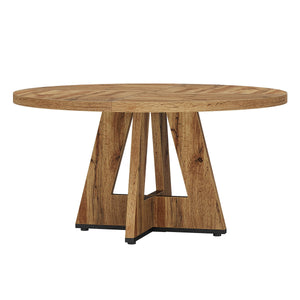







The Tribesigns round farmhouse dining table is one of our best-value picks for anyone who wants a stylish, space-saving dining table at a great price. It comes flat-packed, but the assembly is simple with the included hardware and Allen key.
This guide walks you through how to assemble the table step by step, from checking the parts to attaching the tabletop and making sure the table is stable before use.
Before You Start
Before assembling your Tribesigns dining table, take a few minutes to check all parts and hardware. This round dining table comes with several tabletop panels, a central support frame, pedestal-style table legs, connecting bars, and the required screws and tools. Laying everything out first will make the assembly process much smoother.
We recommend assembling the table on a clean, soft surface, such as a carpet, rug, or flattened cardboard box. This helps protect the tabletop from scratches while you work. Since the tabletop is made of multiple panels, it is also helpful to have another person assist with holding and aligning the pieces during assembly.
Most board parts are labeled or stamped on the raw edge. Match each part with the parts list before you begin. If any part is missing or damaged, contact Tribesigns customer support for a replacement before continuing with assembly.

What’s Included in the Box
Before you begin, check that all main parts are included in the package.
|
Part No. |
Part Name |
Quantity |
|
1 |
Tabletop panels |
4 pcs |
|
2 |
Pedestal base panels |
4 pcs |
|
3 |
Round support frame |
1 pc |
|
4 |
Support bar |
1 pc |
|
5 |
Connecting rail |
1 pc |
Hardware and Tools
Separate the hardware by letter before assembly so each piece is easy to find during the following steps.
|
Hardware No. |
Description |
Quantity |
|
A |
M6 x 15 mm screws |
21 pcs + 1 spare |
|
B |
M6 x 30 mm screws |
8 pcs + 1 spare |
|
C |
φ7 x 47 mm connecting bolts |
24 pcs + 1 spare |
|
D |
φ10 x 50 mm wooden dowels |
8 pcs + 1 spare |
|
E |
Adjustable foot pads |
4 pcs |
|
F |
Metal brackets |
2 pcs |
|
G |
Allen key |
1 pc |
|
H |
Connecting plates |
4 pcs |
Step 1: Assemble the Pedestal Base
Start by taking out the four pedestal base panels labeled Part 2. Arrange the panels as shown in the instruction diagram, making sure the pre-drilled holes face toward the center connection area.
Use the two metal brackets labeled F to connect the base panels at the center. Secure the brackets with 8 pieces of A screws, which are the M6 x 15 mm screws.
Do not fully tighten the screws right away. First, loosely attach all screws so the panels can be adjusted into the correct position. Once the four base panels are properly aligned and form a stable crossed pedestal shape, tighten the screws securely.
Tip: Use the shorter A screws for this step. Do not use the longer B screws here, as they are reserved for a later step.
Step 2: Attach the Round Support Frame
Next, place the round support metal frame labeled Part 3 on top of the assembled pedestal base. Align the holes on the support frame with the holes at the top of the pedestal panels.
Use 16 pieces of C bolts to secure the round support frame to the base. Insert all bolts first, then tighten them gradually. This helps keep the frame centered and prevents the table base from shifting during assembly.
Before moving to the tabletop installation, check that the pedestal base stands straight and that the round support frame is firmly attached. The frame should sit evenly on top of the base, with no major gaps or loose connections.

Step 3: Insert the Wooden Dowels into the Tabletop Panels
Place the four tabletop panels labeled Part 1 on a clean, soft surface with the finished side facing down. Arrange the panels in a circle so the pre-drilled holes along the straight edges line up with each other.
Insert 4 wooden dowels labeled D into the holes on the edges of the tabletop panels. These dowels help guide the panels into the correct position and keep the tabletop aligned during assembly.
Make sure each dowel is pushed in straight. Do not force it at an angle, as this may damage the holes or make the tabletop difficult to connect in the next step.
Step 4: Connect the Tabletop Panels
Carefully slide the tabletop panels together, using the wooden dowels as alignment guides. The four panels should come together to form a complete round tabletop.
Check that the curved outer edges create a smooth circle and that the seams between the panels are even. If the panels do not fit together easily, gently pull them apart and check that the dowels are fully inserted and properly aligned.
Once the panels are connected, keep the tabletop flat on the floor or work surface. Do not lift it yet, as the panels still need to be secured in the following steps.

Step 5: Position the Base on the Tabletop
Keep the tabletop flat with the underside facing up. Carefully place the assembled pedestal base and round support frame onto the center of the tabletop.
Align the base with the pre-drilled holes on the underside of the tabletop. Make sure the round support frame sits evenly and the pedestal base is centered before adding screws.
Use 4 connecting plates labeled H and 12 A screws to secure the tabletop connection points. Start all screws by hand first, then tighten them with the Allen key.
At this stage, tighten the screws to about 75% only. Leaving them slightly loose makes it easier to adjust the alignment before the final tightening step.
Tip: Check that the seams between the tabletop panels are still even and that the round edge looks smooth before moving on.
Step 6: Secure the Base to the Tabletop
Once the base is centered and the tabletop panels are properly aligned, use 8 B screws to fasten the round support frame firmly to the tabletop.
Insert all B screws into the pre-drilled holes first. After every screw is in place, tighten them evenly in a crisscross pattern. This helps distribute pressure and keeps the tabletop level.
Now go back and fully tighten all screws, including the A screws from the previous step. Tighten everything to 100%, but avoid over-tightening, as this may damage the tabletop or hardware.
Before turning the table upright, double-check that the base is securely attached and that there are no loose screws.

Step 7: Connect the Support Bars
Take Part 4 and Part 5 and place them in a cross shape as shown in the diagram. Align the center holes where the two bars overlap.
Use 1 A screw to connect the two support bars at the center. At this stage, tighten the screw to about 75% only. Keeping it slightly loose will make it easier to position the support bars onto the pedestal base in the next step.
Make sure the bars are straight and evenly crossed before moving on.
Step 8: Attach the Support Bars to the Pedestal Base
With the tabletop still upside down, place the connected Part 4 and Part 5 support bars on top of the pedestal base. Align the holes on the bars with the pre-drilled holes on the upper section of the base panels.
Important: When installing Part 4 and Part 5, make sure the side with more holes is facing outward.
Use 8 C bolts to secure the support bars to the pedestal base. Insert all bolts first, then tighten them evenly. Once everything is aligned, fully tighten the bolts to 100%.
Before continuing, check that the support bars are firmly attached and that the pedestal base feels stable.

Step 9: Install the Adjustable Foot Pads
With the table still upside down, install the 4 adjustable foot pads labeled E onto the bottom of the pedestal base.
Screw one foot pad into each pre-drilled hole at the end of the base support bars. Turn each foot pad by hand until it is firmly attached.
Do not over-tighten the foot pads. They should be secure, but still adjustable later if the table needs leveling after it is placed upright.
Step 10: Turn the Table Upright and Check Stability
After installing all screws, bolts, support bars, and foot pads, carefully turn the dining table upright. This step is easier and safer with two people.
Place the table on a flat floor and check its stability. If the table wobbles, adjust the foot pads at the bottom until it feels steady.
Before use, make sure all screws are fully tightened, the tabletop panels are aligned, and the pedestal base stands straight.
When using the table, keep weight evenly distributed. Avoid placing heavy items only on the outer edge, as this may affect stability.

Final Thoughts
Assembling the Tribesigns round dining table is simple when you organize the parts first and follow the steps in order. For most people, the full assembly can be completed in under 1 hour, especially with two people working together.
Once finished, you’ll have a stylish, space-saving dining table that works well for everyday meals, family gatherings, apartments, breakfast nooks, and small dining spaces.
Finally, thank you for your continued support of Tribesigns.
Read more: